Writing: Multiverse Map
Multiverse Map
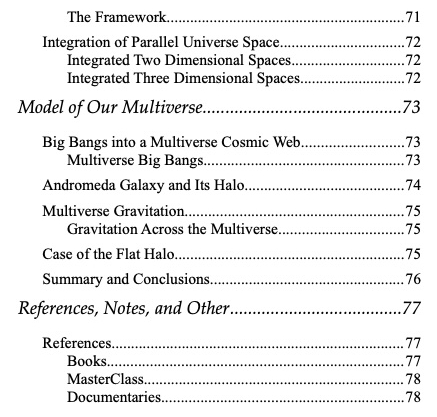
Table of Contents

Preface
This book includes new geometry. How new? Ask Google about “hypercubes without hidden lines.” The AI answer includes content from my Wikipedia Hidden Line article. ChatGPT saw my unique four-dimensional hypercube, and wrote “hidden-line styling is a good visualization aid.” Google Gemini wrote, “Ultimately, the image serves as an excellent illustration of how to visualize a higher-dimensional object.” My four and five dimensional hidden line hypercubes are the first such images posted on the internet.
This story is a walkabout through the tech stack that connects and entertains billions. It’s a journey to map the multiverse, written by someone who saw the very beginning of the digital age. I belong to Generation Jones, the cohort between the Boomers and Gen X. My first global event wasn’t a viral tweet, video or livestream; it was watching the moon landing on a fuzzy, black-and-white tube TV. I sat on the floor at a neighbor’s house as the first astronauts walked on the moon.
I’ve watched the world scale from three analog TV channels to 4K streaming. My career was shaped by the gen Jones giants: Steve Jobs, Bill Gates, Reed Hastings of Netflix, and James Gosling (the father of Java). I used the first IBM PC running Microsoft’s first Disk Operating System on my first consulting job. I worked at Netscape in Silicon Valley just as the web was becoming a household name. Today, I live in the world built by the next generations: I drive a Tesla (and fix it via YouTube), use OpenAI, and navigate the world via Google.
Cultural icons have shifted. Spider-Man was a TV cartoon, now there is a multi-mix of spider-people across the Spider-Verse multiverse. Soundtracks had featured Led Zeppelin, Pink Floyd on the Dark Side of the Moon, AC/DC was on the Highway to Hell, The Doors were Riders on the Storm, Elton John was the Rocket Man, David Bowie was Ziggy Stardust, Rush would Fly by Night, Fleetwood Mac would Go Their Own Way, Queen released Bohemian Rhapsody. Now, there’s Adele looking for Someone Like You, Taylor Swift knows All to Well, and Lady Gaga’s in a Bad Romance; and the bands Linkin Park is Breaking the Habit, Coldplay wrote a song Yellow, and Green Day don’t want to be an American Idiot, and My Chemical Romance singing about Teenagers.
My beginner books were Peanuts, Dracula, The Hobbit, and Foundation, which give way to inspiration storytellers like J.K. Rowling who wrote the Harry Potter series, Malcolm Gladwell who popularized the 10,000-hour rule, Michael Lewis whose book Moneyball became a major film, and my travel hero, Anthony Bourdain who wrote Kitchen Confidential. Bourdain was a rebel who’s job was to travel the world, eat, and meet interesting people. And the scientists like Neil deGrasse Tyson, Brian Cox, Jim Al-Khalili, Sabine Hossenfelder, and string theory experts Brian Greene and Lisa Randall. They are people who took complex, insider worlds and made them accessible. I wanted to do the same for the multiverse.
If you’re intimidated by string theory or the arcane math of relativity, don't be. The graphs in this book are as simple as the ones you drew in high school. I’ve arranged the diagrams like movie storyboards—clear, straightforward action scenes. Following the lead of the legendary physicist Richard Feynman who realized you can visualize a quantum interaction simply with diagrams, I created diagrams to visualize the multiverse.
I’ve taken Nike’s advice: Just do it! Or, as Yoda famously put it, “Do or do not. There is no try.” Wayne Gretzky said, “You miss one hundred percent of the shots you don’t take.” This book is me taking a shot at extending geometry into the multiverse.
To you, the reader: may this book bring happy times of suggestive thoughts and imaginative images across the multiverse.
March 2026
Stacy David
A Universe of Many Dimensions
For two years I wandered across North America as would Crocodile Dundee on an Australian style walkabout. I was a Charles Bukowski social outlier living Tales of Ordinary Madness. I was a Buddhist monk contemplating life paths. I had carried a book of ancient Chinese philosophy and Einstein’s book titled, Relativity.
Einstein wrote of spacetime: the three spatial dimensions in the directions of up and down, left and right, backwards and forwards; and the temporal dimension in the direction of time. I thought there should be more dimensions, but I couldn’t point in the direction of a fourth spatial dimension anymore than I could point in the direction of time.
I was finished being a migrating butterfly living wherever in a tent. I wanted interesting computer work and to study the structure of the universe. My new path would be to university with two goals: 1) Get enough education to work in computers. 2) Figure out how to draw in multiple dimensions.
It was a curious question, how to draw in multiple dimensions? This was before the internet and I couldn’t find a book on drawing n-dimensional cubes. It would take two years to get enough education to work in computers and gain the skills to draw multidimensional cubes.
The practical question was, could a homeless high school dropout handle university courses? In the spring of ‘82, I moved to Winnipeg, Manitoba, Canada, found a bachelor apartment in a house, got a job on a golf course, applied to the University of Manitoba and was conditionally accepted. I signed up for first year, first part of calculus. I passed! I signed up for the second part of calculus. I passed! I received credit for another math course by writing and passing the final exam. I was on my way to major life changes. As I did when I was on the road, I got myself two books. This time, a guide to become a regular urbanite. I bought a sociology book and a book of Shelley’s Romantic age poems.
...