Multiverse Geometry
Wikipedia Pages with Multiverse Geometry Topics
https://en.wikipedia.org/wiki/Multiverse
Section: "Why gravity is weak and the cosmological constant is small",
has the NASA multiverse graphic.
https://en.wikipedia.org/wiki/Brane_cosmology
Section: Brane, has the NASA multiverse graphic.
Multiple Universe Graphing
This is a work in Progress, the first in a sequence to demo a graph with two 3D universes.
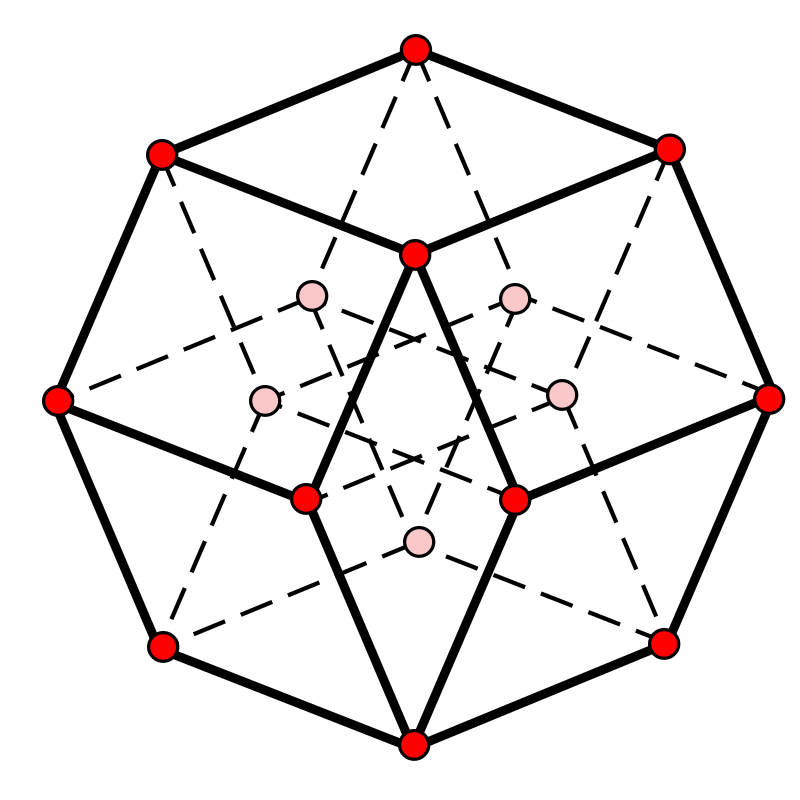
- 3-cube or 4-cube with dashed hidden lines
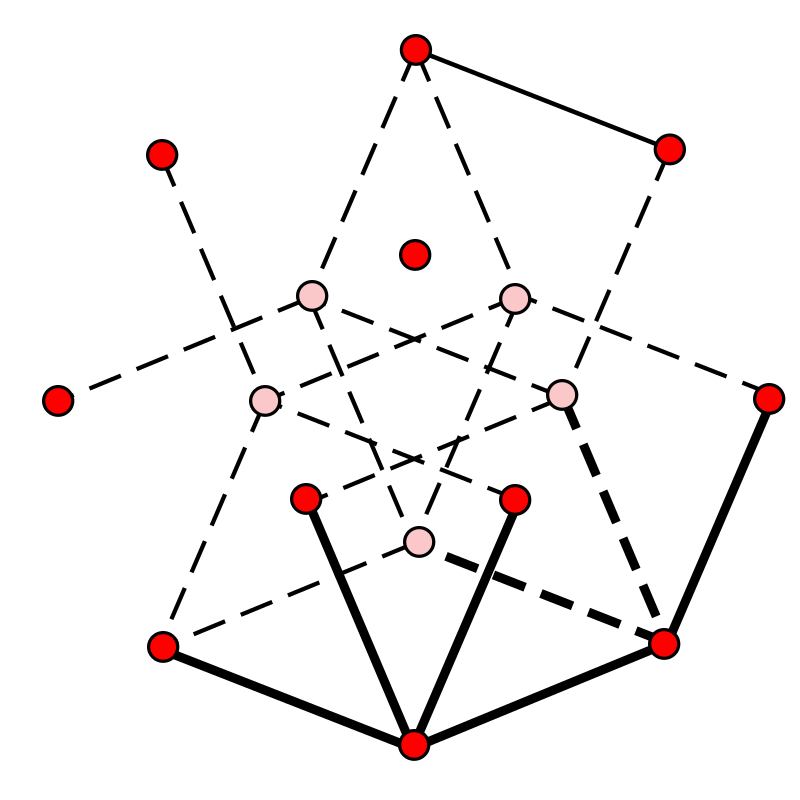
- Highlight the multiverse edges.
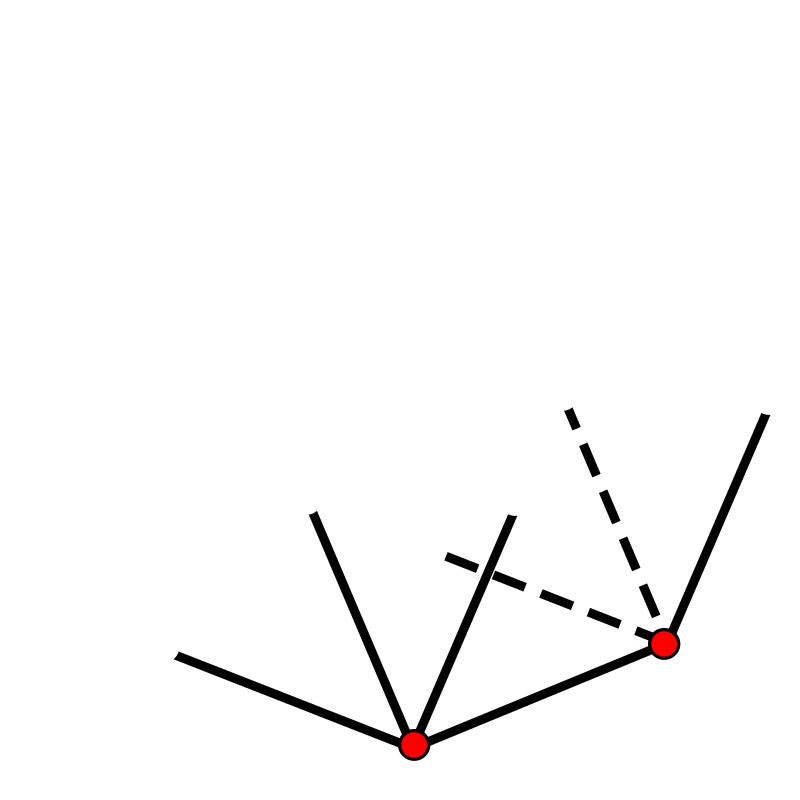
- Remove all but the highlighted edges.
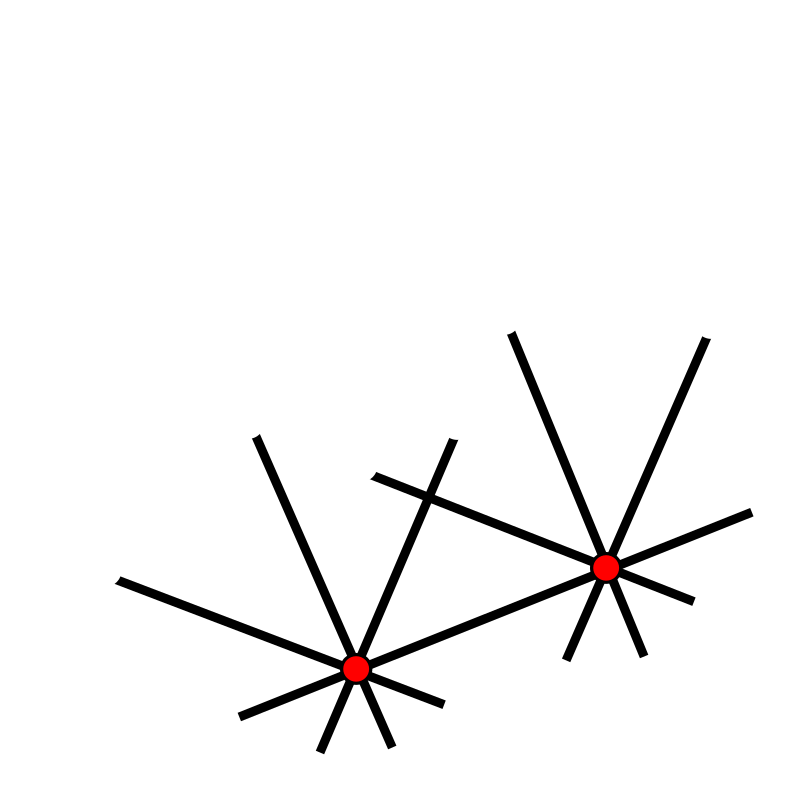
- Extend the graph the show two universes. This is the basic multiverse graph.
| 3-cube with hidden lines | Highlighted MV edges | Only the MV edges | MV graph |
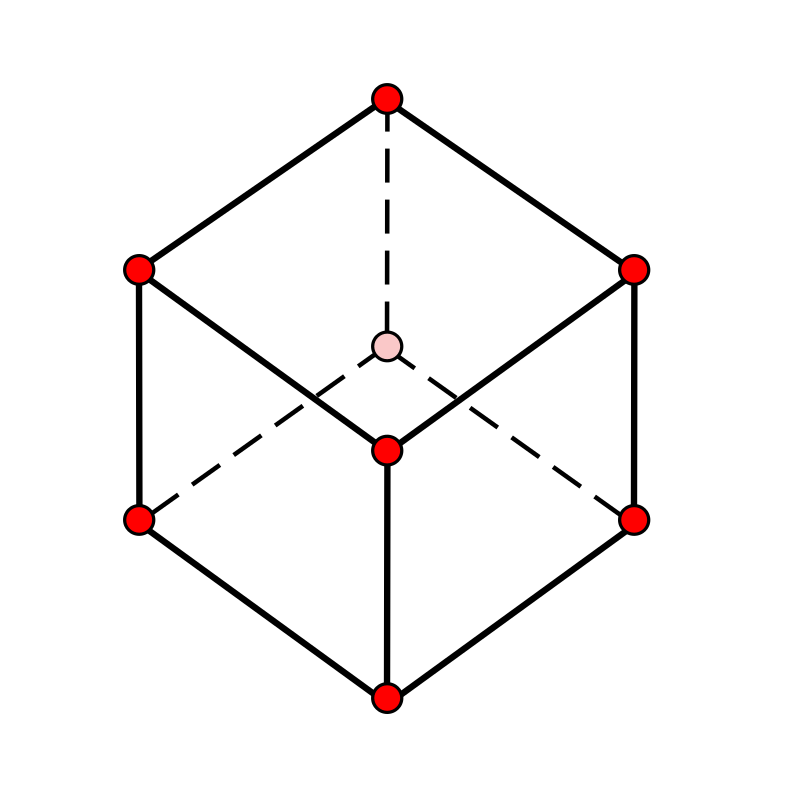
|
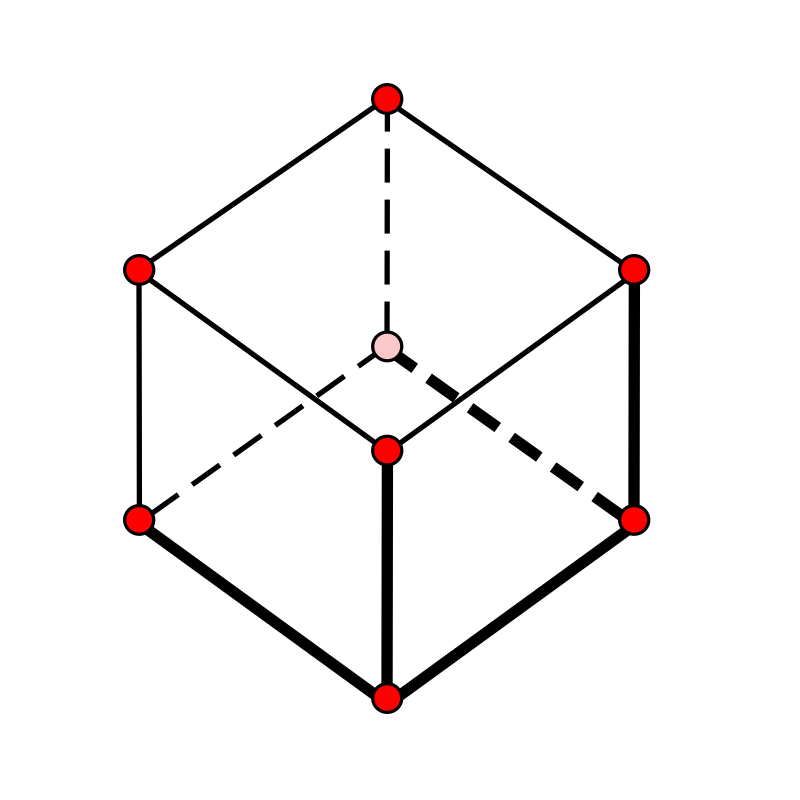
|
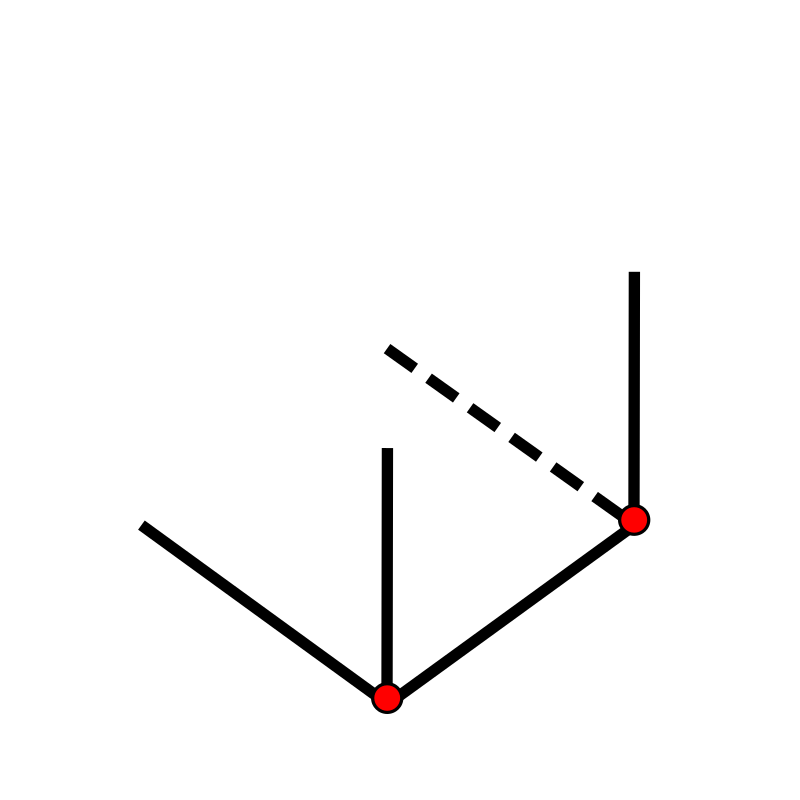
|
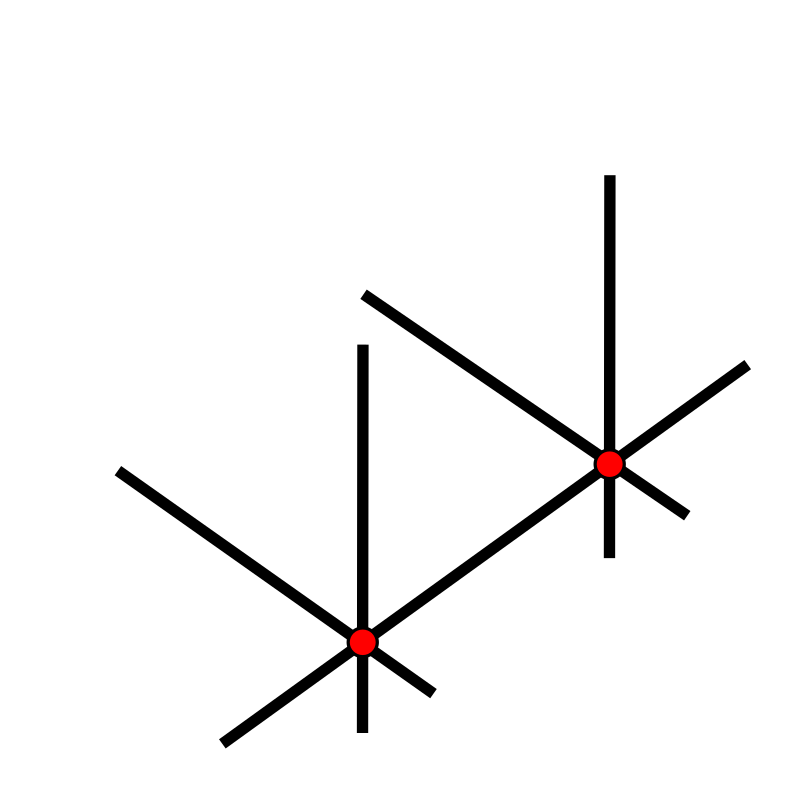
|
| 4-cube with hidden lines | Highlighted MV edges | Only the MV edges | MV graph |
|
|
|
|
String theory Multiverse
String theory includes, brane-world scenario: physicists assume that the observable universe is a four-dimensional subspace of a higher dimensional space called the bulk. Brane: in string theory, a brane is a physical object that generalizes the notion of a zero-dimensional point particle, a one-dimensional string, or a two-dimensional membrane to higher-dimensional objects.

|
[[Brane cosmology]]
|
Article topics
+ Overview introduction: generalized statements and definitions, and geometry of a universe: local and global.
+ Geometric Dimensions, spatial and temporal
+ Are there objects with more than 3 spatial dimensions?
I was fascinated to know there is physical mathematical proof that there is only 3D spatial and one of time.
+ The beginning of the universe.
+ The beginning of the universes.
+ String theory Multiverse
+ Using N-1 dimensions for demonstration. For example, 2D when explaining curved 3D.
+ Bubble Universes
Proposed Wikipedia Page Content
(Section: Introduction and Overview)There is geometry for a single universe and geometry of multiple universes. Geometry of our universe includes [[Euclidean geometry]] where space is viewed as having straight lines, as in a [[Euclidean space]]. And [[non Euclidean geometry]] where space curves in the presents of mass, which is the geometry of [[spacetime]], [[spacetime geometry]] (Wikipeida spacetime topic: curved manifolds). In [[Laura Mersini-Houghton]] book, Before the Big Bang, she writes the phrase "curved spacetime geometries," in a footnote mentioning Einstein(general relativity), Minkowski(spacetime), and Riemann(mathematics), who are the fathers of curved 4 dimensional spacetime.
Euclidean geometry is useful for a global view of your universe as whole whether for our visible universe or beyond to infinity. Non Euclidean geometry is great for localized spatial representations such as the sun causing space to curve.
Constructive [[multi-dimensional geometry]] is useful for diagramming [[multiverse]] concepts such as many dimensional universes, and bubble universes within higher dimensions. Multi-dimensional [[constructive geometry]] uses techniques developed in 1, 2, and 3 dimensions. Methods derived in the first 3 dimensions are applied in higher dimensions. Multi-dimensional geometry includes drawing objects in higher dimensions using drawing techniques developed from drawing 1, 2, and 3 dimensional objects.
The method used to draw 4 dimensional hypercubes is derived from methods for drawing the lower dimensional shapes.

|
1 dimensional [[straight line]],
2D [[square]],
3D [[cube]],
|
(section in progress)
Using N-1 dimensions for demonstration
The page of [[Four-dimensional space]] geometry has space/dimensional analogy.A dimensional analogy is the study of how (n − 1) dimensions relate to n dimensions, and then inferring how n dimensions would relate to (n + 1) dimensions. It is a method to imagine 4 dimensions projected into our 3 spatial dimensions. Since we are 3 dimensional beings, to visualize 4 dimensional objects in our 3 spatial dimensions, we will use techniques from Flatland. The diagrams below shows the sphere, a 3D shape, above the 2D Flatland plane. It moves down into Flatland where it appears as a 2D circle on the Flatland 2D plane. The third diagram shows a sphere has moved below Flatland. As the sphere moves downward and through Flatland, it appears as circle of increasing size, and then the circle shrinks until it disappears as the sphere has gone below Flatland.

|
(x,y,z) sphere falling through (x,y) plane. |
The following N-1 dimension example uses the above diagram sequence.
Instead of sphere, the example uses a
4 dimensional [[hypersphere]].
A hypersphere, or n-sphere,
is the locus of points at equal distance (the radius) from a given center point.
A 1-sphere is a one dimensional circle on a 2 dimensional plane.
A 2-sphere is a two dimensional sphere in 3 dimensions.
A 3-sphere is a three dimensional sphere in 4 dimensions.
Given an (x,y,z,a)
4D [[hypersphere]]
where the dimensions of (x,y,z) are our 3 spatial dimensions.
And (a) is an added 4th spatial dimension.
n-1 for (x,y,z,a), would be:
(x,y,a) 3D sphere falling through (x,y) plane.
(x,z,a) sphere falling through (x,z) plane.
(y,z,a) sphere falling through (y,z) plane.
That's the total of a 4D hypersphere falling through our 3 spatial dimensional planes.
The hypersphere would appears as a point in each of the 3 planes.
As the hypersphere continues to move through our 3 dimensions,
it would be a circle in each of our 3 planes,
which is sphere in our 3 spatial dimensions.
The 3D sphere would increases in size, in our dimensions, to it's maximum size,
then shrinks until it disappears from our 3D space.
+ Edwin Abbott Abbott used dimensional analogy in his book Flatland.
+ Using n-1 dimensions when drawing graph diagrams.
+ Consider showing expansion of space using a (x,y) dimensional sphere. When expanded, enlarged, galaxy clusters are farther apart.
+ By applying dimensional analogy, one can infer that a four-dimensional being would be capable of similar feats in three-dimensions, as a three-dimensional being’s feats from two-dimensional being.
+ Projections: A useful application of dimensional analogy in visualizing higher dimensions is in projection. A projection is a way of representing an n-dimensional object in n − 1 dimensions. For instance, computer screens are two-dimensional, and all the photographs of three-dimensional people, places, and things are represented in two dimensions by projecting the objects onto a flat surface
Are there objects with more than 3 spatial dimensions?
In a space with more than three dimensions, there can be no traditional atoms and perhaps no stable structures. A space with less than three dimensions allows no gravitational force and may be too simple and barren to contain observers.
In 1917, [[Paul Ehrenfest]] showed that neither classical atoms nor planetary orbits can be stable in a space with more than 3 spatial dimensions. Tangherlini also showed that traditional quantum atoms cannot be stable in a space with more than 3 spatial dimensions. If there is only a single time dimension and more than three spatial dimensions, the orbit of a planet about its Sun cannot remain stable. [References, [[Spacetime]], [[Dimensions of spacetime]]]
In his article, Max states that when there are more than 3 dimensions, two-body problem no longer has a stable orbit solution. He goes on to show why there could only be one temporal time dimension with the 3 spatial dimensions. It's a strong argument that only 3+1-dimensional spacetimes are inhabitable by intelligent life. [Reference, On the dimensionality of spacetime (PDF), February 1997, by [[Max Tegmark]] (tegmark@mit.edu), Institute for Advanced Study, Princeton]

|
Max Tegmark's dimensional chart.
|
From a pragmatic point of view, as a 3D [[sphere]] would move through 2D space, a 4D [[hypersphere]] would move through 3D space: the sphere or hypersphere would appear as point in the lower dimensional space, grow from small to a maximum size, then shrink out existence in the lower dimensional space. Objects appearing and disappearing have not been observed and are not scientifically reproducible in our 3 dimensional universe. Not being scientifically observable does not confirm 4 dimensional objects do not exit, however it does support Ehrenfest's theory and Tegmark's argument that we do not live in a universe of objects greater that 3 dimensions, that we live in a 3 dimensional universe, a universe of 3 dimensional objects.
Drawing Objects in a Multi-dimensional Universe
Reference Notes
Types of Geometry
The 2 major types are those that have drawings or non-coordinate graphs, and that which is geometry using coordinates and coordinates graphs.
[[Euclidean geometry]] is constructive geometry. Constructive geometry redirects to: [[Straightedge and compass construction]] geometry. Also known as ruler-and-compass construction or Euclidean construction. There are methods for creating things with no more than a compass and an unmarked straightedge. Euclidean geometry is more concrete than other systems such as set theory which can assert something’s existence with a method to create it within the system.
[[Non-Euclidean geometry]] ...
[[Synthetic geometry]] is geometry without the use of coordinates. It is sometimes referred to as axiomatic geometry or even pure geometry. It includes Euclidean geometry which is a mathematical system described in Euclid’s textbook on geometry, Elements. Euclid's approach consists in assuming a small set of intuitively appealing axioms (postulates) and deducing many other propositions (theorems) from these, logically derived.
[[Projective geometry]]
...
In essence,
a projective geometry may be thought of as an extension of Euclidean geometry
in which the "direction" of each line is subsumed within the line as an extra "point",
and in which a "horizon" of directions corresponding to coplanar lines is regarded as a "line".
Thus, two parallel lines meet on a horizon line by virtue of their incorporating the same direction.
Idealized directions are referred to as points at infinity,
while idealized horizons are referred to as lines at infinity.
In mathematics,
the concept of a
[[projective space]]
originated from the visual effect of perspective,
where parallel lines seem to meet at infinity.
Axioms of projective space
Any given geometry may be deduced from an appropriate set of axioms.
Projective geometries are characterized by the "elliptic parallel" axiom,
that any two planes always meet in just one line, or in the plane;
any two lines always meet in just one point.
In other words,
there are no such things as parallel lines or planes in projective geometry.
Projective geometry later proved key to Paul Dirac's invention of quantum mechanics.
In more advanced work,
Dirac used extensive drawings in projective geometry to understand the intuitive meaning of his equations,
before writing up his work in an exclusively algebraic formalism.
[[Analytic geometry]]
is based on a coordinate system to express geometric properties by means of algebraic formulas, geometry into algebra. Examples, a line: y = 2x + 1, a circle: x2 + y2 = 7.
[[Cartesian space]]
was Euclidean in structure.
Britannica article under multidimensional space, mathematics: Arthur Cayley, British mathematician. Cayley was in Trinity College, Cambridge, in 1838-1846. In 1863 he accepted the Sadleirian professorship in mathematics at Cambridge.
In geometry Cayley concentrated his attention on analytic geometry, for which he naturally employed invariant theory. For example, he showed that the order of points formed by intersecting lines is always invariant, regardless of any spatial transformation. In 1859 Cayley outlined a notion of distance in projective geometry (a projective metric), and he was one of the first to realize that Euclidean geometry is a special case of projective geometry—an insight that reversed current thinking. Ten years later, Cayley’s projective metric provided a key for understanding the relationship between the various types of non-Euclidean geometries.
Albert Einstein's theory of general relativity is that physical space itself is not Euclidean. General relativity is based on a self-consistent non-Euclidean geometry.
Drawing Cubes and Spheres
For a [[cube]]:
+ Centered at the origin: (0,0,0),
+ With edges parallel to the axes and with an edge length of 2,
+ The [[Cartesian coordinates]]
of the vertices are
(±1, ±1, ±1)
while the interior consists of all points
(x0, x1, x2) with −1 < xi < 1 for all i.
Formally, a [[sphere]] is the set of points that are all at the same distance r from a given point in three-dimensional space. A sphere is hallow. A solid sphere is referred to as ball. Bubbles such as soap bubbles take a spherical shape in equilibrium.